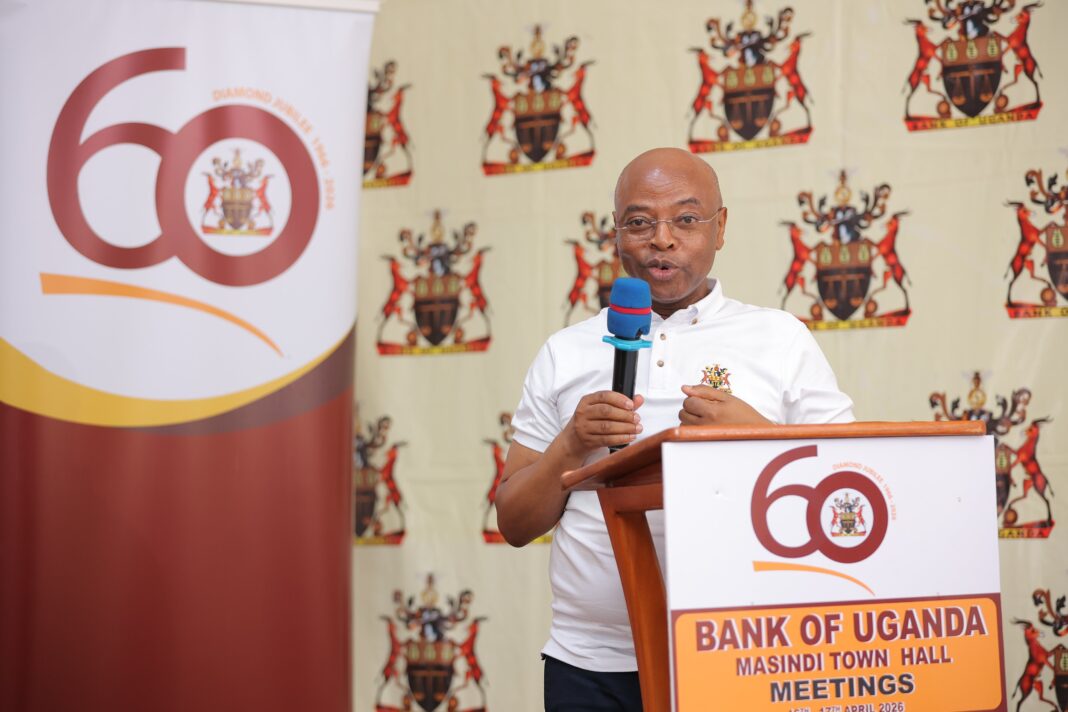
The Deputy Governor of the Bank of Uganda, Prof. Augustus Nuwagaba, has called for deeper financial inclusion, increased access to affordable credit, and stronger public understanding of monetary policy as key drivers of Uganda’s socioeconomic transformation.
Prof. Nuwagaba made the remarks during a town hall meeting with district leaders in Masindi District held on April 17, 2026, under the theme: “Understanding the role of Bank of Uganda in the socioeconomic transformation of Uganda.”
He said the central bank continues to engage citizens across the country to explain its mandate and gather feedback, noting that national development requires collaboration between institutions and the public.
Quoting scripture, he said: “As the Bible asks in Amos 3:3, ‘Do two walk together unless they have agreed to do so?’ We not only need to walk together, we need to develop Uganda’s economy together.”
The Deputy Governor highlighted that 2026 marks 60 years since the establishment of the Bank of Uganda, noting the institution’s role in maintaining price stability, strengthening the financial sector, and supporting economic resilience through decades of change.
BoU Mandate and Financial Stability
Prof. Nuwagaba explained that the bank’s core mandate includes maintaining price stability through monetary policy tools such as the Central Bank Rate, supervising financial institutions, issuing currency, regulating payment systems, and supporting affordable credit initiatives.
He noted that inflation remains low and stable, contributing to predictable economic conditions for households and businesses.
On financial supervision, he said the Bank of Uganda currently oversees 22 commercial banks, including Centenary Bank, Stanbic Bank, Pearl Bank, and Equity Bank operating in Masindi, urging residents to compare services and choose institutions that best meet their needs.
He also highlighted ongoing regulation of large Savings and Credit Cooperative Organisations (SACCOs), noting that several have already been licensed, including the Masindi District Farmers Association SACCO.
Currency Protection and Digital Payments
The Deputy Governor raised concern over poor cash handling practices that increase currency printing costs, including writing on banknotes and improper storage.
“Protecting the integrity of our currency reduces printing costs and frees resources for development programmes,” he said, while reminding the public that all denominations, including lower-value coins, remain legal tender.
On digital finance, he warned of risks such as fraud and cybercrime in mobile money systems, urging users to safeguard PINs, avoid suspicious messages, and report fraudulent activity promptly.
Credit Facilities for Growth
Prof. Nuwagaba encouraged farmers and entrepreneurs in Masindi—where agriculture, especially sugarcane farming, dominates—to take advantage of government-supported credit schemes such as the Agricultural Credit Facility and the Small Business Fund.
He said the facilities are designed to support mechanisation, agro-processing, irrigation, and expansion of small businesses, including for borrowers without traditional collateral.
Vision for Economic Transformation
Linking the discussion to Uganda’s long-term strategy, he referenced the government’s Tenfold Growth Strategy, which aims to grow the economy from about USD 50 billion to USD 500 billion by 2040.
He said Masindi is well positioned to benefit from this transformation due to its agricultural potential, tourism proximity to Murchison Falls, and the Tilenga oil and gas developments.
Prof. Nuwagaba reaffirmed the central bank’s commitment to building a stable and inclusive financial system, urging residents to actively engage with financial institutions and participate in available economic opportunities.
“Your feedback today will go a long way in improving our services to Ugandans,” he said.