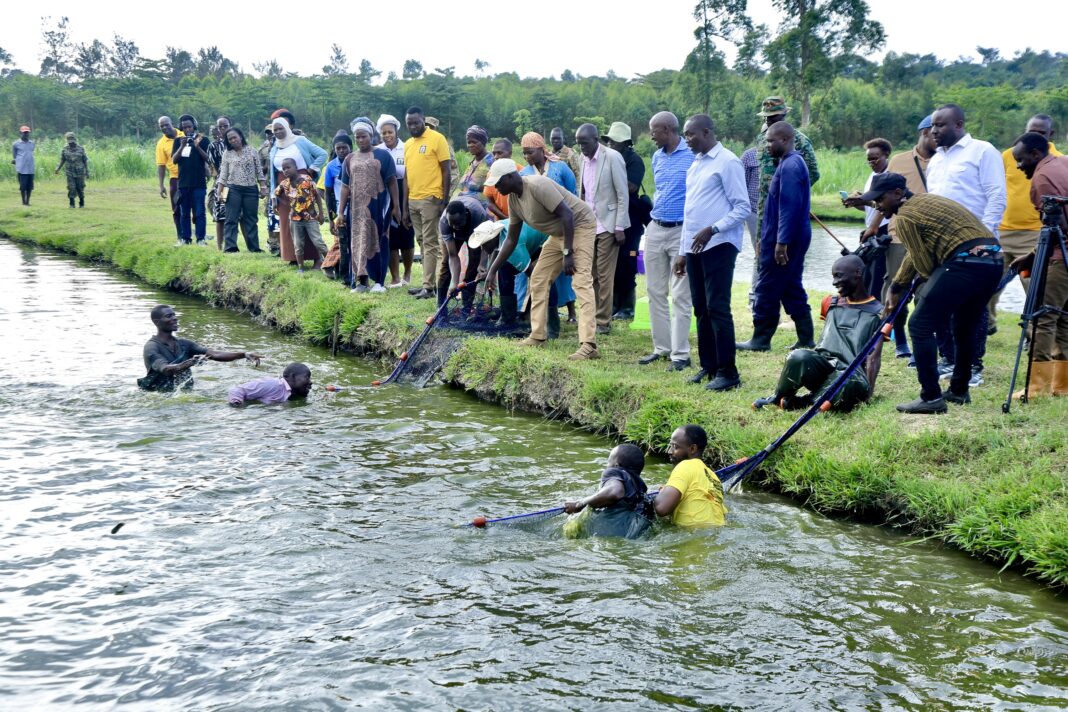
The State House Comptroller, Jane Barekye, has officially launched the sale of fish at the Mengo Zonal Industrial Hub in Kayunga District, marking a key milestone in the government’s push to promote aquaculture as a sustainable income-generating activity.
The launch showcased fish harvested from ponds established under the government’s four-acre model, an initiative designed to help communities utilize land productively while preserving wetlands.
“Under this hub we have several enterprises, and among them is fish farming where we teach farmers how to utilize wetlands without destroying the environment,” Ms Barekye said. “We have decided to launch the selling of fish that has been growing in these ponds. We have three ponds here, but two are ready for harvest.”
The Mengo Zonal Industrial Hub is part of a broader presidential initiative spearheaded by Yoweri Kaguta Museveni to equip youth and communities with practical skills and income-generating enterprises. Fish farming has been integrated into the hubs as a model for balancing economic activity with environmental conservation.
Speaking at the event, the Director of Presidential Projects and Industrial Hubs, Raymond Kamugisha, said the activity in Kayunga demonstrates the viability of aquaculture under the four-acre model.
“We are here to witness one of the four components of the presidential initiative in industrial hubs. Fish farming is one of them, and it plays a critical role in preserving wetlands without interfering with infrastructure,” he said.
Eng. Kamugisha noted that fish farming offers significant financial returns, explaining that a pond measuring about 1,000 square metres on one acre can generate up to Shs100 million annually after deducting operational costs such as feeding.
He called on Ugandans, particularly those living near wetlands, to embrace fish farming as a practical pathway to wealth creation while safeguarding the environment.
The launch of fish sales at the hub is expected to inspire wider adoption of aquaculture, especially among youth enrolled in industrial hubs, by demonstrating that the initiative can translate training into tangible income.
Officials say the integration of fish farming into the industrial hubs aligns with national efforts to promote sustainable livelihoods, reduce pressure on wetlands, and expand household income opportunities across rural communities.